When you review your year-end performance, one of the most valuable assets you have is the set of Q4 error data from your operations. By converting that raw information into actionable insights, you can build a durable operations blueprint 2026, a strategy that ensures you’re not repeating failure but refining your system. In this article, we’ll focus on transforming Q4 metrics into real improvement, and show how partnering with a fulfilment expert like Order Fulfilment Experts (OFEX) can make that transition smoother and smarter.
Why Q4 error data is your goldmine, not just your headache
Spotting the hidden patterns in mistakes
During the final quarter, one of the busiest and most unpredictable times for fulfilment, warehousing, and logistics, many brands collect vast amounts of fault and error data. These might include delayed shipments, picking errors, returns surges, stock mis-allocations, or system outages. If you examine only the headline figures, you’ll miss the story underneath: the “why” behind the failures.
From meltdown to metrics: changing your mindset
Instead of seeing Q4 as “just a crash season we survived”, treat it as a live case-study, and the first draft of your operations blueprint. By analysing those mistakes systematically, you move from reactive firefighting (“What went wrong?”) to proactive design (“How do we make it better?”). The result: you’re not just coping in 2026, you’re optimising.
Why business owners should care
- You free up working capital by reducing waste (returns, re-work, extra labour).
- You improve customer experience (fewer delays, fewer complaints, fewer errors).
- You build a more scalable, resilient operation when you partner with someone who understands the data and the logistics behind it.
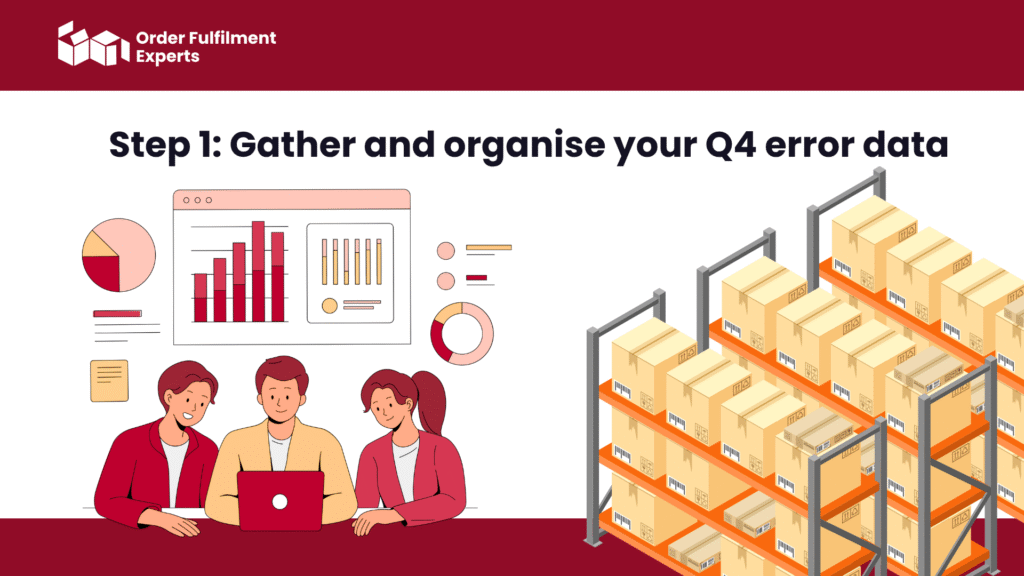
Step 1: Gather and organise your Q4 error data
Define what “error” means for your operation
Before you can transform your data, you must clearly define what counts as an error. Some examples: order pick-errors, mis-ships, late deliveries, stock discrepancies, returns due to fulfilment fault, carrier failures, system downtime. Frame them in terms your business recognises.
Create a comprehensive data capture framework
Work with your team or your fulfilment partner to ensure every fault gets recorded: what happened, when, where, by whom, and what the outcome was. Structure your spreadsheet or database so you can sort by SKU, channel, date, location, root cause.
Tip: Use categories and severity ratings
By assigning error categories (e.g., “picking”, “shipping”, “returns”, “tech”), and severity ratings (mild, moderate, severe), you’ll be able to quickly identify patterns when you analyse metrics later.
Step 2: Analyse and interpret your Q4 error metrics
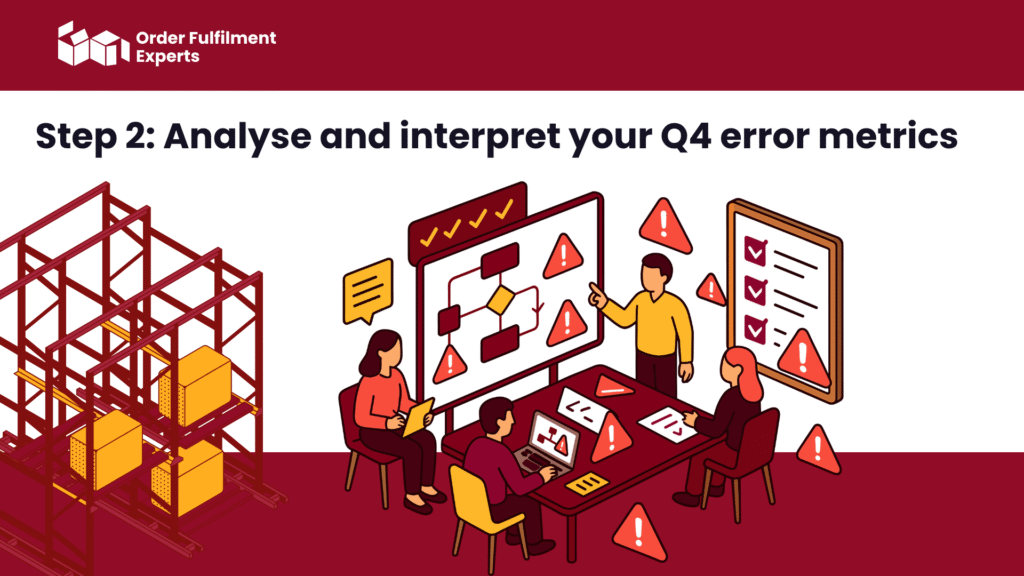
Seek patterns, not just counts
Once you’ve gathered your data, the next step is to ask: where are the clusters? Is one SKU generating 50% of pick errors? Is a particular warehouse zone causing most mis-ships? Is your marketplace channel outsizing your in-house fulfilment capacity? By focusing on patterns, you shift from “lots of errors” to “specific failure modes”.
Apply key metrics to understand impact
Important metrics include:
- Error rate per 1,000 orders
- Cost per error (labour re-work + shipping + refund)
- Time to resolve the error
- Customer impact (delay in days, complaint volume)
- Repeat error rate (did the same issue occur multiple times?)
Use root-cause charts and Pareto analysis
Apply techniques such as the 80/20 rule: 80% of the cost may come from 20% of error types. Use visual tools (bar charts, heat maps) to isolate hotspots. Then you can set a priority for improvement.
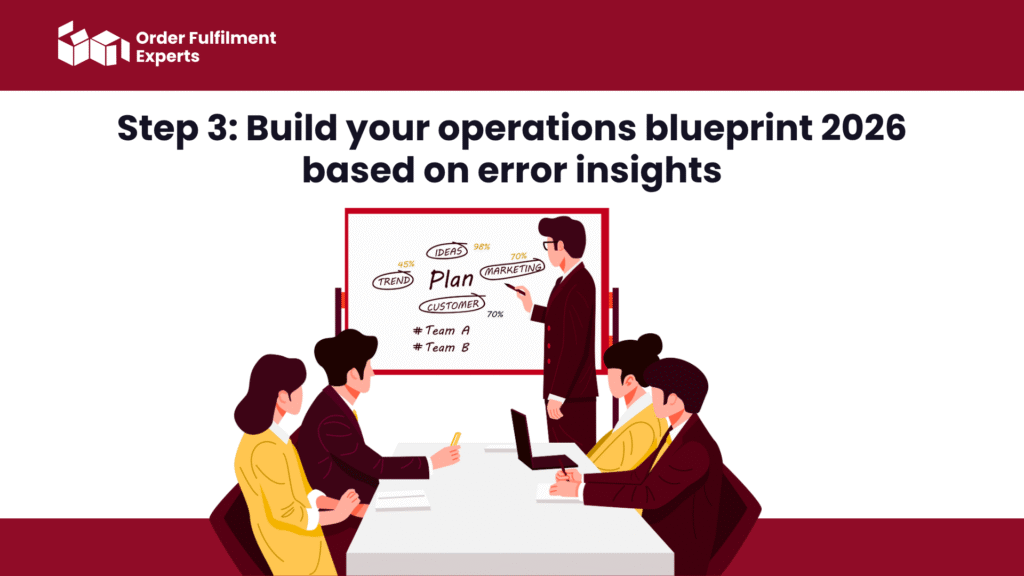
Step 3: Build your operations blueprint 2026 based on error insights
Translate findings into strategic improvements
With error metrics in hand, you’re in a position to craft your operations blueprint for 2026. Each high-impact failure becomes an opportunity: e.g., “We’ll reduce pick-error rate by 30% by redesigning zone layout and implementing scanning by Q2 2026.”
Prioritise improvements by impact & effort
Not all fixes need the same resource. Use a matrix: x-axis = effort/cost, y-axis = impact/reduction in error cost. Tackle quick wins first (small effort, big impact) while planning for larger investments (e.g., automation) over time.
Define KPIs, owners, and timelines
For each improvement, include: target error rate, responsible person or team, deadline, and monitoring method. This makes your blueprint actionable, not just a wish-list.
Step 4: Implement operational changes and monitor progress
Operationalising the blueprint
Translate strategy into everyday tasks. For example:
- Week 1: train staff on new pick-paths
- Month 1: launch new SKU-labelling system
- Q1: roll-out batch-scanning equipment
- Q2: integrate fulfilment partner dashboard
Continuous monitoring and feedback loops
Use your metrics from Step 2 to monitor progress. Are errors dropping? Are costs going down? Are customers getting shipments faster? Establish weekly or monthly review meetings with key stakeholders (warehouse, operations, fulfilment partner).
Adjust and iterate
If an improvement isn’t working as expected, iterate, ask why, revisit the root cause, and adjust. Treat your blueprint as a living document. In 2026, you’ll be fine-tuning, not just patching.
Step 5: Partnering with a fulfilment expert to accelerate execution
Why partnering with a specialist like OFEX matters
You may have excellent internal operations, but scaling for peak periods or international expansion often exposes gaps. That’s where a partner like OFEX adds value: they bring infrastructure, technology, and proven processes designed to handle volume without meltdown.
How a fulfilment partner helps your operations blueprint 2026
- They preload transforming Q4 metrics insights into your fulfilment configuration (zone layout, SKU priority, carrier choice).
- They give you dashboards and transparency to track error metrics and fulfilment performance.
- They enable you to flex capacity, reduce your own fixed overheads, and turn unpredictable costs into predictable service costs.
- They free you to focus on your brand, product, and marketing, while they handle fulfilment, shipping, returns, and the operations behind it.
Example case: scaling without the panic
Imagine a brand that doubled SKUs and added marketplaces at the start of Q4. They found pick-errors rose 45% and returns climbed. By partnering with OFEX ahead of 2026, they redesigned their fulfilment flow, used multi-zone picking, introduced better warehouse management, and reduced the error rate by 27% in the next campaign. Their operations blueprint 2026 became “scale smart, not just scale fast”.
Common pitfalls to watch out for and how to avoid them
Pitfall 1: Looking only at overall error volume
If you focus only on how many errors occurred, you might miss where the real cost lies (e.g., one error type may cost 10× another). Make sure to value the error by cost, not only count.
Pitfall 2: Not updating the blueprint post-implementation
A blueprint without review becomes shelfware. Ensure you revisit your operations blueprint 2026 quarterly, update targets, scrap tactics that aren’t working, and scale what is.
Pitfall 3: Ignoring customer experience while focusing on internal metrics
You may reduce error rate from 5% to 2%, but if those remaining errors hit your VIP customers, you’ll still suffer reputational damage. Make sure your metrics include customer-facing impact, complaints, NPS drop, and social feedback.
Make Q4 error data your starting point for growth
If you survived the hectic Q4 rush, you’ve got more than stories; you’ve got Q4 error data. By collecting it, analysing it, and turning it into an operations blueprint for 2026, you turn past breakdowns into tomorrow’s growth lever. Transforming Q4 metrics isn’t optional; it’s how scaling brands build resilience, efficiency, and customer loyalty.
If you want to turn your error history into operational excellence, consider the value of working with a trusted fulfilment partner like Order Fulfilment Experts (OFEX). Visit our website at https://orderfulfilmentexperts.co.uk/ and book a consultation.
Connect with us for more insights and updates:
- Facebook: OFEX UK
- Instagram: @ofex_uk
- LinkedIn: Order Fulfilment Experts
Here’s to turning past meltdowns into future metrics and building a smarter, stronger 2026.